Static or dynamic: which one do you need?
Most codes should be static. A static code holds your link inside the picture, so it keeps working with no service behind it. All the other generators on this site make static codes.
Pick dynamic when the link will change after you print: a menu that moves to a new page each season, a flyer for an offer that ends, or a sign whose page you have not built yet. A dynamic code holds a short q.qrotto.com link, and you choose where that link sends people.
The full comparison is in our guide on static versus dynamic QR codes.
What you get, free
- Change the link any time from your private edit link. The printed code keeps working.
- No account. No email, no password, no trial that runs out.
- No ads when scanned. One redirect, straight to your page.
- Scan counts by country, device type and day, with no history limit.
- Your own link name if you want one, such as q.qrotto.com/ali-cafe-menu.
- Colours and a logo, with the error level raised automatically when a logo covers the middle.
- No lock-in. Download your data, or a plain QR code that points straight to your page, from the edit page at any time.
How to make one
- Open q.qrotto.com and paste the https:// link the code should open.
- Optionally pick a link name, colours and a logo, then press Create code.
- Download the PNG, and save the edit link with Copy or Download. It is the only way to change the code later.
- Scan the printed code once yourself before handing it out. Our stress test shows how small you can print it.
How we keep it safe
Free redirect services attract scammers, and a scam on one code hurts trust in all of them. So links must use https://, short links and other QR redirects are refused, link names that imitate banks or logins are blocked, and anyone can check or report a code without opening it. A code with several reports is paused until it is checked. Adding a plus sign to any code link, like q.qrotto.com/ali-cafe-menu+, shows where it goes first.
We store the link, the edit key and scan counts. We do not store the IP address or details of anyone who scans. The rules are on the dynamic code terms page.
Static or dynamic: the honest comparison
The actual technical difference
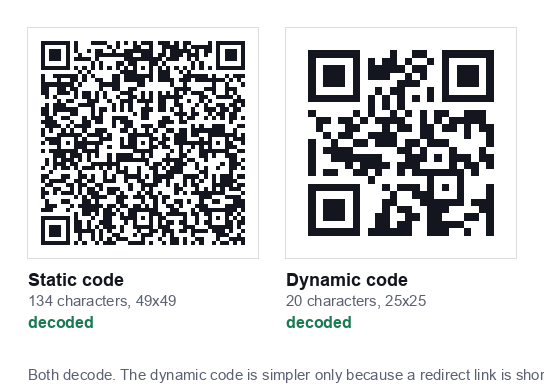
A static QR code contains your data inside the image. The URL, the WiFi password, the contact details, physically encoded in the pattern. Scanning reads the data straight off the image. No server is involved at any point.
A dynamic QR code contains a short link to a provider's server. Scanning opens that link, the server looks up where it currently points, and redirects the phone to the real destination. The data you care about lives in the provider's database, not in the code.
Everything else follows from this one difference.
Side by side
| Compared on | Static | Dynamic |
|---|---|---|
| Data location | Inside the image | On a provider's server |
| Change destination later | No | Yes |
| Scan analytics | No | Yes |
| Works if the provider disappears | Yes | No |
| Works offline | Yes (for WiFi and text) | No, needs internet |
| Pattern density | Depends on data length | Always small (short link) |
| Ongoing cost | None | Usually monthly |
| Privacy | No third party involved | Provider logs every scan |
The risk nobody mentions in the sales page
Every dynamic QR code you print becomes a dependency. If the provider raises prices, changes terms, gets acquired, shuts down, or your card expires, every printed code stops working at once. Menus, packaging, signage, business cards: all of it, simultaneously.
This is not hypothetical. QR code services have shut down and taken working codes with them, and several have moved previously free features behind paid tiers, leaving users with printed material that stops resolving unless they subscribe.
A static code has no such failure mode. It is a picture of your data. It will scan in ten years exactly as it does today.
When dynamic is genuinely the right call
There are real cases. Be honest about whether yours is one:
- Large print runs where the destination will definitely change. Ten thousand product boxes with a link to a campaign that ends in three months.
- Marketing campaigns where scan data drives decisions. If you are comparing performance across placements, you need counts.
- Campaigns needing granular analytics: scans by location, time, device, which specific poster performed.
- Retargeting. Ad platforms can build audiences from scanners.
The pattern: dynamic earns its cost when the printing is expensive relative to the subscription, or when measurement genuinely changes what you do next.
When static is the better choice
- WiFi codes. There is no dynamic equivalent worth having, a WiFi code must work before the guest has internet, which rules out a redirect entirely.
- Contact cards. Your details change rarely, and you reprint cards anyway when they do.
- Anything printed in small volume where reprinting costs less than a year of subscription.
- Long lived signage pointing at a stable address, your homepage, your review link.
- Anything where a dead code would be a serious problem: safety information, equipment labels, access instructions.
Questions
Is the dynamic QR code really free?
Yes. There is no paid plan and no limit on scans. You can make up to 20 new codes a day from one connection, which stops spam without getting in the way of normal use.
Do I need an account?
No. When you make a code you get a private edit link. That link lets you change where the code goes, see scans, or turn the code off. Save it, because we cannot send it to you again.
Will people see an ad when they scan?
No. A scan goes straight from q.qrotto.com to your page with a single redirect. There is no waiting page, ad or sign-up wall in between.
What happens if QRotto stops running?
A dynamic code depends on the service that redirects it, ours included. That is why every edit page has a button to download a plain QR code that points straight to your page, and why our terms promise at least 90 days of notice before any shutdown. If your link will never change, a static code is still the safer choice.
Can I choose my own link name?
Yes. Open Custom link name and pick something like q.qrotto.com/ali-cafe-menu. People see this name when they scan, so a clear name helps them trust it. Names that imitate banks, logins or big brands are blocked.